Revision Total Knee Replacement in Faridabad: When Your Knee Replacement Has Failed

Best Total Shoulder Replacement in Faridabad: Which Type Do You Need & What to Expect
July 15, 2026
Best Frozen Shoulder Treatment in Faridabad: Why Your Shoulder Is Stiffening and How to Get It Moving Again
July 20, 2026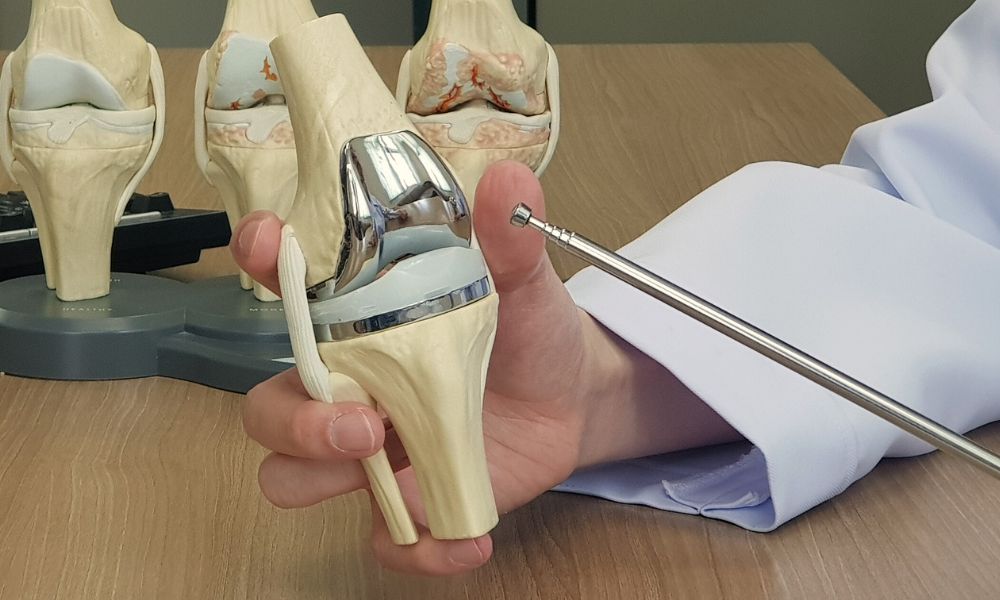
You went through knee replacement surgery with the expectation that your pain was finally behind you. And for years — perhaps even a decade or more — it was. But now the pain is back. Or it never fully went away. The knee feels unstable, stiff, or simply wrong. You’re being told your implant has failed and that you need another surgery.
Revision total knee replacement in Faridabad — the surgical procedure to remove and replace a failed knee implant — is among the most technically demanding operations in all of orthopaedic surgery. It requires a surgeon with specific subspecialty experience in revision arthroplasty: the skills, tools, and implant systems to handle altered anatomy, bone loss, and the mechanical challenges left by a previous procedure.
At Dr. Sunil Choudhary’s Bone & Joints Clinic, revision knee replacement is one of his core subspecialty focuses — built on UK training and more than two decades of high-volume primary and revision joint replacement experience in Faridabad.
Why Do Knee Replacements Fail? Understanding the Common Causes
Knee implants are designed to last 15–20 years with appropriate activity levels. But not every replacement achieves this. The most common reasons a knee replacement fails are:
1. Aseptic Loosening (Most Common)
The implant becomes loose from its bony attachment — without infection. Over time, microscopic wear particles generated by the implant surfaces stimulate an inflammatory response that gradually dissolves the surrounding bone (osteolysis). When enough bone is resorbed, the implant loses its fixation and begins to move.
Symptoms: New onset of pain — often felt as deep, aching pain worsening with activity and improving with rest. A distinctive “start-up” pain with the first few steps after sitting is characteristic.
2. Periprosthetic Joint Infection (PJI)
Bacterial infection of the knee replacement — one of the most serious complications. Can be early (within weeks of surgery) or late (years afterward, from haematogenous seeding during a distant infection).
Symptoms: Pain, swelling, warmth, and sometimes fever. The critical distinguishing feature from aseptic loosening is the inflammatory profile — elevated CRP, ESR, and joint aspiration showing high white cell counts.
Treatment: Always requires surgical intervention — either single-stage or two-stage exchange revision depending on infection timing, organism sensitivity, and patient health.
3. Implant Instability
An imbalanced knee — where soft tissue tension is asymmetric in flexion or extension — produces a feeling of giving way, persistent pain, and difficulty with activities requiring knee control on uneven surfaces.
4. Stiffness and Arthrofibrosis
Excessive scar formation around the knee after replacement leads to restricted range of motion that fails to respond to physiotherapy. Severe arthrofibrosis with less than 70° of flexion may require surgical intervention.
5. Component Wear and Fracture
The polyethylene (plastic) bearing surface between the metal components wears over decades of use. Advanced wear can cause mechanical symptoms (catching, clicking) and accelerate osteolysis. In some cases, the implant components themselves may fracture.
6. Periprosthetic Fracture
A fracture of the bone adjacent to or around the implant — typically from a fall in an older patient with osteoporotic bone. May require revision depending on the fracture pattern and implant stability.
7. Implant Malpositioning
In some cases, the primary replacement was not optimally positioned — leading to abnormal wear patterns, instability, or patient-reported “wrongness” that persists from the time of surgery. Modern robotic joint replacement technology significantly reduces this risk in primary surgery.
Diagnosing a Failed Knee Replacement
A systematic evaluation is essential before revision surgery to identify the specific failure mode — because the treatment for loosening is fundamentally different from the treatment for infection.
Investigations typically required:
- Weight-bearing X-rays — assessing implant position, alignment, component interface, and bone stock
- CT scan — precise assessment of component rotation and bone loss extent
- Nuclear medicine scan (bone scan / white cell scan) — identifying loosening or infection activity
- Blood inflammatory markers — CRP, ESR, D-dimer; elevated values suggest infection
- Knee joint aspiration — culture and cell count for definitive infection diagnosis
- Synovial fluid analysis — alpha-defensin and other biomarkers for periprosthetic joint infection
Revision Total Knee Replacement Surgery in Faridabad: What It Involves
Revision knee replacement is substantially more complex than primary surgery. The operating time is longer, blood loss is greater, and the surgical challenges are unique to each case.
Key aspects of revision surgery:
Implant Removal
The existing components are carefully removed — preserving as much bone stock as possible. Cemented implants require specialised removal tools; biologic (cementless) implants that have integrated into bone require controlled separation to minimise bone loss.
Bone Defect Management
Almost every revision case involves some degree of bone loss — from osteolysis, infection, or mechanical damage. Defects are classified by size and location and addressed using:
- Bone cement — for small, cavitary defects
- Metal augments — modular blocks attached to the revision implant to fill moderate defects
- Structural bone graft — for large defects requiring biological reconstruction
- Trabecular metal cones or sleeves — for very large defects, providing porous ingrowth surfaces for biological fixation
Revision Implant Selection
Revision implants are more constrained and longer-stemmed than primary implants — distributing load over a larger bone area and compensating for lost soft tissue stability. The extent of constraint required depends on the degree of ligamentous insufficiency around the knee.
Infection Cases — Two-Stage Exchange
When infection is the cause of failure, a two-stage procedure is typically performed:
- Stage 1: Remove infected implants; debride all infected tissue; implant an antibiotic-loaded cement spacer (delivers high local antibiotic concentrations)
- Antibiotic course: 6–12 weeks of systemic antibiotics targeting the specific organism
- Stage 2: Reimplantation of a new revision knee replacement once infection is eradicated (confirmed by repeat aspiration and blood markers)
Recovery from Revision Knee Replacement: Realistic Expectations
Recovery from revision surgery is generally longer and more demanding than primary knee replacement:
- Hospital stay: 4–7 days (longer than primary)
- Weight-bearing: Dependent on bone graft use and fixation quality — some patients are partial weight-bearing initially
- Physiotherapy: Begins day 1 but progresses more cautiously than primary recovery
- Return to independent walking: 6–10 weeks
- Full functional recovery: 6–12 months
Expectations should be calibrated to the reason for revision:
- Revision for aseptic loosening without significant bone loss: outcomes approaching those of primary replacement
- Revision for major bone defects or infection: more modest functional goals; primary aim is pain relief and stability
For a foundation understanding of knee replacement that contextualises revision surgery, read: Everything You Need to Know About Knee Replacement Surgery in Faridabad.
Why Experience Matters Most in Revision Knee Replacement
Revision knee surgery is not the procedure to choose based on geographical convenience or cost alone. The variables are too many, the implant choices too complex, and the intraoperative decision-making too nuanced for a surgeon without dedicated revision experience.
Dr. Sunil Choudhary’s subspecialty focus on both primary and revision total knee replacement in Faridabad — built on UK training and high-volume practice over 20+ years — means his patients receive the kind of systematic, well-planned revision surgery that achieves durable results even in the most challenging cases.
Conclusion: Expert Revision Knee Replacement in Faridabad
A failed knee replacement is not the end of the road. With the right preoperative diagnosis, the right surgical plan, and the right surgeon, revision total knee replacement in Faridabad reliably restores pain-free function to patients whose original replacement has let them down.
At Dr. Sunil Choudhary’s Bone & Joints Clinic, every revision case receives the thorough evaluation, meticulous planning, and subspecialty surgical expertise that this complex procedure demands.
Book Your Revision Knee Replacement Consultation
Don’t live with a failing knee replacement. Expert revision surgery is available in Faridabad.
+91 971-776-7209 | +91 997-170-9209