Best Frozen Shoulder Treatment in Faridabad: Why Your Shoulder Is Stiffening and How to Get It Moving Again

Revision Total Knee Replacement in Faridabad: When Your Knee Replacement Has Failed
July 18, 2026
Partial Hip Replacement in Faridabad: Who Needs It, What’s Different from Total Hip, and What to Expect
July 22, 2026
It usually starts quietly. A mild ache in the shoulder that you assume is a muscle strain. Then, over weeks, the pain deepens. And then — almost imperceptibly at first — the range of motion starts to shrink. Reaching behind your back becomes difficult. Reaching overhead becomes impossible. Sleeping on the affected side wakes you in pain. Welcome to frozen shoulder — one of the most frustrating and underestimated orthopaedic conditions.
The good news: frozen shoulder treatment in Faridabad at Dr. Sunil Choudhary’s Bone & Joints Clinic offers an evidence-based pathway through every stage of this condition — from early pain management through physiotherapy and, when necessary, arthroscopic surgical release that can restore movement in a single procedure.
What Exactly Is Frozen Shoulder (Adhesive Capsulitis)?
Frozen shoulder — medically called adhesive capsulitis — is a condition in which the fibrous capsule surrounding the shoulder joint becomes inflamed, thickened, and contracted. As the capsule tightens, the normally capacious shoulder joint space shrinks dramatically — restricting movement in all directions.
The condition affects approximately 2–5% of the population, with higher rates in:
- Adults aged 40–60 (peak incidence)
- Women (slightly higher prevalence than men)
- Patients with diabetes mellitus (diabetic frozen shoulder is often more severe, more prolonged, and more resistant to treatment)
- Patients with thyroid disorders
- Patients who have been immobilised following shoulder surgery or injury
- Patients following a cardiac event or stroke
Important distinction: Frozen shoulder can be primary (idiopathic — no identifiable cause) or secondary (arising after a precipitating event such as rotator cuff tear, shoulder surgery, or prolonged immobility).
The Three Stages of Frozen Shoulder
Understanding these stages helps set realistic expectations for both patient and surgeon:
Stage 1 — Freezing (Painful Phase): 2–9 Months
The capsule is actively inflaming. This stage is characterised by:
- Progressive, increasing shoulder pain — often worst at night
- Gradual restriction of movement developing alongside the pain
- Severe pain at the end ranges of motion
- Often the most distressing stage for patients
Management focus: Pain control — anti-inflammatory medication, corticosteroid injections into the glenohumeral joint (most effective during this stage), and gentle pendulum physiotherapy to prevent further stiffness.
Stage 2 — Frozen (Stiff Phase): 4–12 Months
The acute inflammation subsides but the scar tissue remains. This stage is characterised by:
- Reduced pain at rest — often the night pain that was so distressing in Stage 1 begins to ease
- Severe restriction of movement in all planes — internal rotation, external rotation, and elevation all significantly limited
- A “rubbery” end-feel when the shoulder is moved to its range limits
Management focus: Physiotherapy to maintain and gradually restore range of motion; hydrodilatation (joint distension injection) may be offered.
Stage 3 — Thawing (Recovery Phase): 5–26 Months
The contracture gradually resolves and movement slowly returns. Most patients recover full or near-full movement, but this phase can take up to 2 years without intervention.
The critical problem: Without any treatment, total duration of frozen shoulder ranges from 1–3 years in most patients — with a minority having permanent restriction. This is why “wait and see” without active management is generally not acceptable.
Non-Surgical Treatments for Frozen Shoulder in Faridabad
Most patients with frozen shoulder are successfully managed without surgery — but the key word is “managed.” Passive waiting produces slower, less complete recovery than active treatment.
Physiotherapy
The cornerstone of frozen shoulder management. A trained physiotherapist uses:
- Pendulum exercises — gentle gravity-assisted oscillation to maintain joint space
- Passive and active-assisted stretching — progressively increasing range of motion as tolerated
- Joint mobilisation techniques — manual therapy to address specific movement restrictions
- Strengthening — as range returns, graduated strengthening prevents secondary muscle wasting
Physiotherapy must be gentle — aggressive stretching during the painful freezing stage can worsen inflammation and accelerate capsular scarring.
Corticosteroid Injections
The most effective non-surgical intervention for frozen shoulder, particularly during the freezing stage. An intra-articular corticosteroid injection reduces inflammation, relieves pain, and accelerates progression through the stages.
Key evidence: Injections in the freezing stage produce better outcomes than injections in the frozen stage — making early diagnosis and intervention important.
Hydrodilatation (Distension Arthrography)
A procedure in which the shoulder joint is distended with saline (and often corticosteroid) under imaging guidance — physically stretching the contracted capsule. Evidence supports modest benefit in the frozen stage.
Manipulation Under Anaesthesia (MUA)
An older technique in which the shoulder is forcibly moved through its full range while the patient is under general anaesthesia — physically breaking the adhesions. Results are inconsistent; risk of fracture around the shoulder during forced manipulation has led most surgeons to prefer arthroscopic release.
Arthroscopic Capsular Release: When Surgery Is the Right Step
For patients who have not recovered sufficiently after 6–9 months of appropriate non-surgical management, arthroscopic capsular release provides the most reliable and reproducible restoration of shoulder movement.
What the procedure involves:
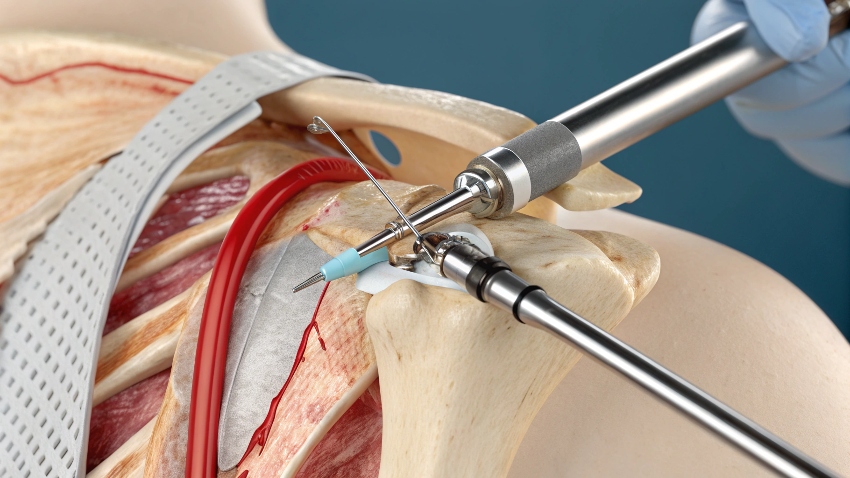
Using the arthroscope and a radiofrequency probe inserted through 2–3 small incisions around the shoulder, Dr. Sunil Choudhary systematically divides the contracted capsule — releasing the tight anterior, inferior, and posterior portions that are restricting movement. The procedure also allows simultaneous treatment of any coexisting conditions identified on arthroscopy.
What to expect after arthroscopic release:
- Immediate improvement in shoulder range of motion — often measurable on the operating table after release
- A regional nerve block (interscalene) administered at the time of surgery provides 12–18 hours of effective post-operative pain relief
- Physiotherapy begins the day after surgery — this is critical to maintain the movement gained during the release
- Most patients achieve near-full range of motion within 3–6 months of surgery
For diabetic frozen shoulder patients: Surgery is still effective but recovery may be more prolonged and require more intensive physiotherapy. Dr. Choudhary works closely with the patient’s diabetologist to optimise blood sugar control before and after surgery, as elevated HbA1c directly impairs healing.
Bankart Repair: The Related Shoulder Arthroscopy Procedure
While frozen shoulder and Bankart repair are distinct conditions, both involve arthroscopic shoulder surgery and benefit from the same surgical expertise and post-operative rehabilitation framework.
Bankart repair addresses recurrent shoulder instability — the opposite problem from frozen shoulder. Where frozen shoulder makes the joint too tight, an unstable shoulder with a Bankart lesion is too loose, repeatedly dislocating because the labrum (cartilage rim) has torn.
Dr. Choudhary performs bankart repair in Faridabad arthroscopically — reattaching the torn labrum to the glenoid rim with suture anchors, restoring the shoulder’s natural stability.
Both conditions — frozen shoulder and instability — sit within Dr. Choudhary’s broader shoulder subspecialty, along with rotator cuff repair and shoulder replacement.
How Long Does Frozen Shoulder Take to Resolve with Treatment?
With appropriate treatment, most patients see significant improvement within 6–12 months. Key milestones:
- After corticosteroid injection: Measurable pain and stiffness improvement within 4–6 weeks
- After hydrodilatation: Gradual improvement over 4–8 weeks
- After arthroscopic release: Immediate range improvement; near-full recovery in 3–6 months with physiotherapy
Without treatment, natural resolution can take 1–3 years — with incomplete recovery in a proportion of patients.
Conclusion: Don’t Let Frozen Shoulder Freeze Your Life — Expert Treatment Is in Faridabad
Frozen shoulder is one of the most disruptive orthopaedic conditions — but it is also one of the most treatable when managed correctly from an early stage. Whether you’re in the painful freezing phase and need effective pain control, the stiff phase needing progressive physiotherapy, or you’ve exhausted conservative options and need arthroscopic release — Dr. Sunil Choudhary provides the best frozen shoulder treatment in Faridabad for every stage of the condition.
Early diagnosis. Staged, evidence-based treatment. Arthroscopic surgical capability when needed. And genuine subspecialty shoulder expertise — earned through UK training and 20+ years of dedicated practice.
Book Your Frozen Shoulder Consultation Today
Your shoulder shouldn’t be getting stiffer every week. Get it evaluated and treated.
+91 971-776-7209 | +91 997-170-9209