Partial Hip Replacement in Faridabad: Who Needs It, What’s Different from Total Hip, and What to Expect

Best Frozen Shoulder Treatment in Faridabad: Why Your Shoulder Is Stiffening and How to Get It Moving Again
July 20, 2026
Sciatica Pain Treatment in Faridabad: Why Back and Leg Pain Needs Expert Assessment
August 1, 2026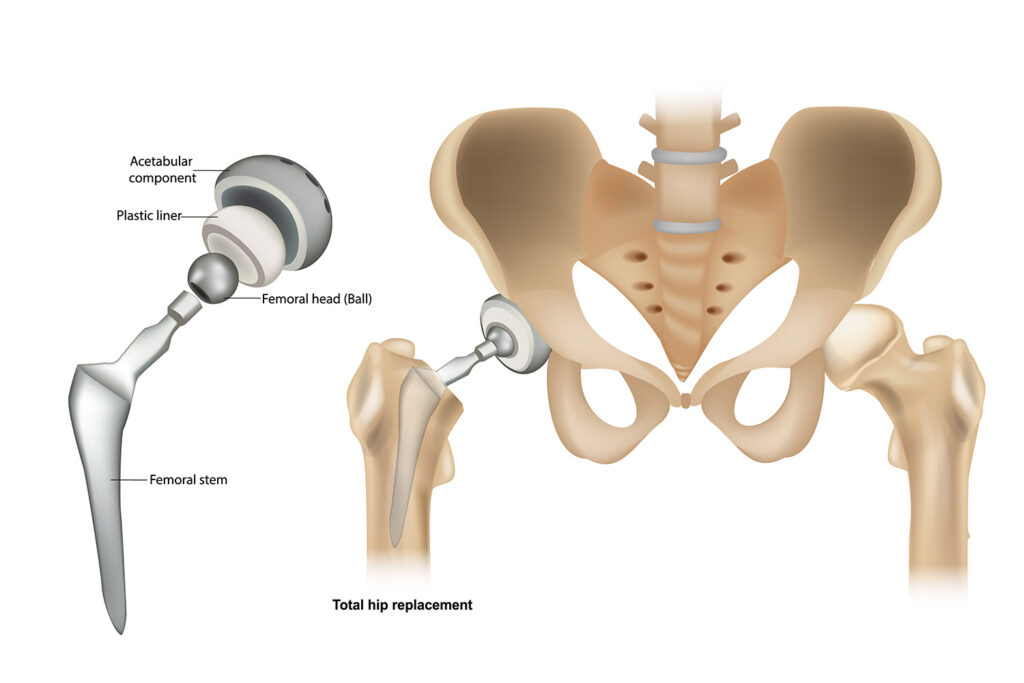
When most people hear “hip replacement,” they picture the complete removal and replacement of both sides of the hip joint — the ball (femoral head) and the socket (acetabulum). This is a total hip replacement, and it remains the most common elective orthopaedic procedure for end-stage hip arthritis. But it is not the only hip replacement option, and it is not always the right one.
Partial hip replacement in Faridabad — technically called hemiarthroplasty (meaning “half joint replacement”) — replaces only the femoral head (the ball) while leaving the natural acetabular socket intact. This distinction is not minor. It changes the indication, the operative complexity, the recovery timeline, and the longevity profile of the procedure entirely.
At Dr. Sunil Choudhary’s Bone & Joints Clinic, understanding which hip replacement a patient actually needs — partial or total, cemented or uncemented, standard or dual mobility — is the foundation of every hip reconstruction plan.
What Is Partial Hip Replacement (Hemiarthroplasty)?
Hemiarthroplasty literally means “half-joint arthroplasty.” In this procedure:
- The damaged or fractured femoral head is removed
- A metal femoral stem is inserted into the femoral shaft (thighbone)
- A metal or bipolar femoral head is attached to the stem — replacing the ball component only
- The native acetabulum (socket) is left completely untouched
The artificial femoral head now articulates directly with the patient’s own acetabular cartilage — providing a smooth, pain-free, functional joint without the need to reshape or implant a component into the socket.
This distinction from total hip replacement is clinically crucial — and the decision between the two procedures is made based on entirely different criteria.
Who Is a Candidate for Partial Hip Replacement in Faridabad?
Displaced Femoral Neck Fractures in Elderly Patients — The Primary Indication
The most common indication for hemiarthroplasty — by far — is a displaced intracapsular femoral neck fracture (Garden III or IV) in an elderly patient.
When an elderly patient (typically over 65–70) falls and sustains a displaced femoral neck fracture, the blood supply to the femoral head is disrupted. Attempting to fix the fracture with screws or a sliding hip screw risks the femoral head dying (avascular necrosis) — requiring a further, more complex operation. Replacing the femoral head immediately with a prosthesis avoids this risk, gets the patient walking faster, and removes the need for a second operation.
Why hemiarthroplasty rather than total hip replacement for these fractures?
Total hip replacement (THR) requires a functioning acetabular cartilage, is technically more complex, takes longer to perform, and carries higher early risk of dislocation — particularly in elderly patients with cognitive impairment or reduced mobility. For lower-demand elderly patients with no pre-existing acetabular disease, hemiarthroplasty provides excellent functional results with lower operative risk and shorter surgical time.
For younger, more active patients with femoral neck fractures (under 65, physiologically fit, high activity demands), total hip replacement is generally preferred because the native acetabular cartilage will wear excessively against a metal femoral head over the active decades ahead.
Avascular Necrosis (AVN) of the Femoral Head — Selected Cases
Avascular necrosis — death of the femoral head bone from interrupted blood supply — occurs from:
- Steroid medications (the most common cause in India)
- Sickle cell disease
- Alcohol use
- Previous hip trauma
- Idiopathic (no identifiable cause)
In early to intermediate-stage AVN where the femoral head is collapsing but the acetabular cartilage remains well-preserved, hemiarthroplasty may be appropriate. However, if there is significant acetabular cartilage wear — which occurs as the collapsed, irregular femoral head erodes the socket — total hip replacement is required instead.
Hip Tumours Requiring Femoral Head Resection
In selected cases where a tumour affects the proximal femur and femoral head without acetabular involvement, hemiarthroplasty is performed as part of the oncological management — preserving the native socket while replacing the compromised femoral bone.
Partial vs. Total Hip Replacement: Making the Right Decision
This is the most critical decision in hip replacement planning — and it is one that requires an experienced surgeon who can evaluate the acetabular cartilage status honestly, rather than defaulting to one procedure for all patients.
| Feature | Partial Hip (Hemiarthroplasty) | Total Hip Replacement |
| Acetabulum replaced | No — native socket retained | Yes — prosthetic socket inserted |
| Operative time | 45–75 minutes | 90–150 minutes |
| Dislocation risk | Slightly lower | Slightly higher (technique-dependent) |
| Blood loss | Less | More |
| Ideal patient | Elderly fracture patient; lower activity demands | Active patient; arthritis; avascular necrosis with socket involvement |
| Longevity | 10–15 years before possible conversion | 15–20+ years |
| Groin pain risk | Higher (native cartilage wear over time) | Lower (new socket eliminates native cartilage) |
For everything to consider before any hip surgery: Hip Replacement Doctor in Faridabad — Everything to Know Before Surgery
Types of Hemiarthroplasty Implants
Not all partial hip replacements are the same. The implant choice significantly affects functional outcomes:
Unipolar Hemiarthroplasty
A single metal femoral head articulates directly against the native acetabular cartilage. Simpler and less expensive — but the fixed head size may not match the patient’s natural anatomy precisely, increasing cartilage wear over time.
Bipolar Hemiarthroplasty
A double-bearing design: the metal femoral head is enclosed within a polyethylene-lined outer head — creating two articulation surfaces. The inner bearing (metal on polyethylene) absorbs most motion; the outer bearing (prosthetic head on native socket) experiences much less motion and wear. This design reduces acetabular cartilage wear and groin pain compared to unipolar designs.
At Dr. Sunil Choudhary’s clinic, bipolar hemiarthroplasty is the preferred implant for most patients undergoing partial hip replacement — providing better long-term acetabular cartilage preservation.
Cemented vs. Uncemented Stems
Cemented stems — fixed with polymethylmethacrylate (bone cement) — provide immediate stability; preferred in elderly patients with osteoporotic bone where reliable bone in-growth cannot be expected.
Uncemented stems — porous-coated for biological bone fixation — appropriate for younger patients with adequate bone stock. Provides a more durable long-term fixation.
For patients with osteoporosis that may influence bone quality for fixation: Best Osteoporosis Surgeon in Faridabad
For patients with co-existing hip arthritis to understand the osteoarthritis context: Best Osteoarthritis Surgeon in Faridabad
The Surgical Procedure: What Happens During Partial Hip Replacement
The procedure is performed under spinal or general anaesthesia. The approach — posterior, lateral (direct lateral or anterolateral), or anterior — is chosen based on patient anatomy, surgeon preference, and dislocation risk profile.
Surgical steps:
- Skin incision (8–12 cm) exposing the hip capsule
- Hip dislocation — the femoral head is dislocated from the socket
- Femoral neck osteotomy — the neck is cut at the planned level
- Femoral head removal — the damaged head is extracted
- Femoral canal preparation — a broach progressively expands the canal for the stem
- Stem insertion — cemented or uncemented
- Bipolar or unipolar head attachment
- Hip reduction — the prosthetic head is relocated into the native socket
- Wound closure in layers
Total operative time: 60–90 minutes Hospital stay: 2–4 days Weight-bearing: Same day to next day with walking frame for most patients
Recovery After Partial Hip Replacement in Faridabad
Recovery from hemiarthroplasty is typically faster than total hip replacement — particularly for elderly patients for whom rapid mobilisation is critical in preventing the complications of prolonged immobility (pneumonia, deep vein thrombosis, pressure sores).
| Stage | Timeline | Goals |
| Acute | Day 1–3 | Stand and walk with frame; pain management |
| Early mobilisation | Week 1–2 | Stairs; independent mobility with walking aid |
| Home recovery | Week 2–6 | Increasing walking distance; hip precautions |
| Functional recovery | Week 6–12 | Return to daily activities; driving |
| Full recovery | 3–4 months | Independent, pain-free mobility |
Hip precautions (preventing dislocation):
- Do not bend the hip beyond 90° in the early recovery period
- Do not cross the legs
- Do not twist toward the operated side
- Use a raised toilet seat for 6–8 weeks
When Partial Hip Replacement Needs to Be Converted to Total Hip Replacement
Long-term follow-up data shows that a proportion of hemiarthroplasty patients — typically those who remain active over many years — develop groin pain and deteriorating function as the native acetabular cartilage wears against the prosthetic femoral head. When this occurs, conversion to total hip replacement replaces the socket component without removing the existing stem — a manageable procedure for an experienced hip revision surgeon.
For patients who may eventually need hip revision surgery: Revision Total Hip Replacement in Faridabad
For comparison with knee revision surgery to understand the broader revision arthroplasty context: Revision Total Knee Replacement in Faridabad
Why Dr. Sunil Choudhary for Partial Hip Replacement in Faridabad?
As a UK-trained orthopaedic subspecialist with dedicated joint replacement expertise:
- Accurate patient selection — the right procedure (partial vs. total) for the right patient, based on clinical and radiological assessment, not convenience
- Implant quality — international-grade bipolar implants with cemented or uncemented fixation based on individual bone quality
- Emergency hip fracture management — displaced femoral neck fractures are assessed and operated on within 24–48 hours wherever possible; delay significantly increases mortality in elderly hip fracture patients
- Comprehensive hip care — from hemiarthroplasty through to total hip replacement and revision hip surgery under one subspecialist roof
For the full spectrum of orthopaedic care: Best Orthopedic Doctor in Faridabad for Knee, Hip & Shoulder Surgery
Conclusion: Partial Hip Replacement in Faridabad — The Right Surgery for the Right Patient
Not every hip problem needs a total hip replacement, and not every patient who needs a hip replacement needs the full procedure. Partial hip replacement in Faridabad — hemiarthroplasty — is the precise surgical solution for displaced femoral neck fractures in elderly patients, selected AVN cases, and hip tumour management: providing fast recovery, reliable pain relief, and excellent functional outcomes when applied to the right indication by the right surgeon.
At Dr. Sunil Choudhary’s Bone & Joints Clinic, every hip replacement decision begins with an honest assessment of what your hip actually needs — ensuring the procedure you undergo is the one most likely to restore your independence, mobility, and quality of life for the longest possible time.
Book Your Hip Consultation with Dr. Sunil Choudhary
Hip fracture emergency or elective consultation — same-week appointments available.
+91 971-776-7209 | +91 997-170-9209