
Arthroscopic Rotator Cuff Repair in Faridabad: When Your Shoulder Needs More Than Rest

Sciatica Pain Treatment in Faridabad: Why Back and Leg Pain Needs Expert Assessment
August 1, 2026
Joint Replacement Surgeon in Faridabad: Knee, Hip & Shoulder — Your Complete Decision Guide
August 7, 2026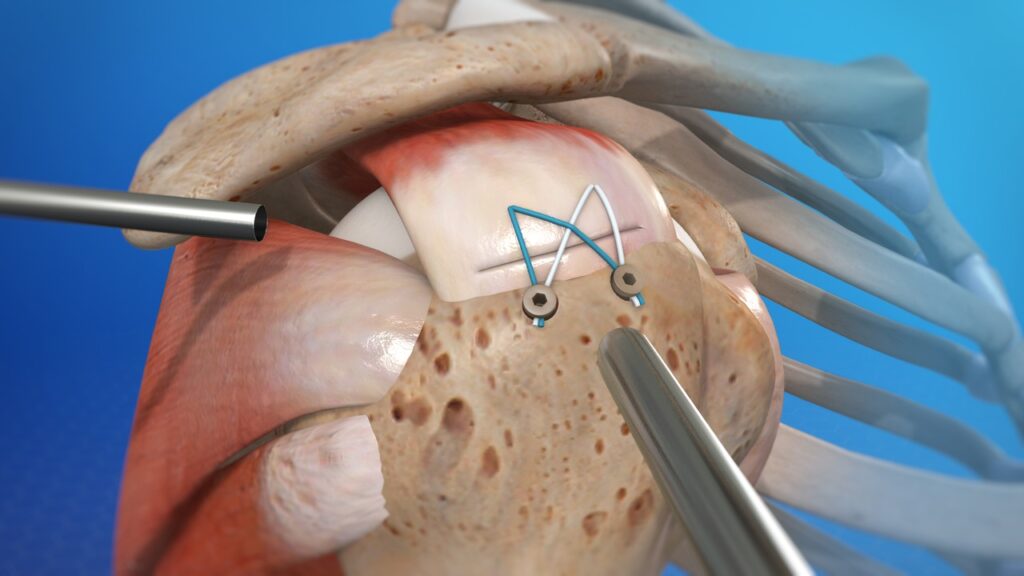
The shoulder is the most mobile joint in the human body — and that extraordinary mobility depends entirely on four small muscles and their tendons forming a dynamic cuff around the humeral head. The rotator cuff. When one or more of these tendons tears — partially or completely — the result is a shoulder that can no longer function without pain, weakness, and progressive deterioration if left untreated.
Arthroscopic rotator cuff repair in Faridabad at Dr. Sunil Choudhary’s Bone & Joints Clinic provides the full spectrum of surgical repair for torn rotator cuffs — from partial-thickness tears repaired endoscopically to massive, complex tears requiring augmentation techniques. As an orthopedic doctor in Faridabad with UK fellowship training in shoulder surgery, Dr. Choudhary brings subspecialty depth to one of orthopaedics’ most technically demanding procedures.
The Rotator Cuff: Anatomy and Function
The rotator cuff consists of four muscles and their tendinous insertions into the humeral head:
- Supraspinatus — initiates shoulder abduction (raising the arm from the side) and contributes to elevation; the most commonly torn tendon
- Infraspinatus — external rotation of the shoulder
- Teres minor — external rotation and adduction
- Subscapularis — internal rotation; torn in fall-forward mechanisms and in combined injuries
Together, these four tendons compress the humeral head against the glenoid socket — providing dynamic stability that allows the shoulder’s extraordinary range of motion without dislocation.
How Rotator Cuff Tears Occur
Degenerative (Age-Related) Tears
The most common mechanism. The supraspinatus tendon, as it passes through the subacromial space (the gap between the humeral head and the acromion bone above), is subjected to repetitive mechanical compression with every overhead movement. Over decades, this produces progressive tendon degeneration — initially partial-thickness tears, eventually full-thickness tears.
Risk factors for degenerative rotator cuff tears:
- Age over 50 (most common; incidence increases with each decade)
- Acromion morphology — a hooked Type III acromion creates more subacromial impingement
- Repetitive overhead activities — painting, plastering, overhead sports
- Smoking — impairs tendon blood supply and healing capacity
- Previous corticosteroid injections — very rarely, can accelerate tendon degeneration
Acute Traumatic Tears
A sudden high-energy event — a fall on an outstretched hand, a direct blow to the shoulder, a sudden overhead jerk — can tear a previously healthy tendon. Traumatic tears are more common in younger patients and in those with pre-existing tendinopathy. They often produce immediate, severe pain and sudden weakness.
Recognising a Rotator Cuff Tear: Key Symptoms
A rotator cuff tear should be suspected when the following are present:
- Shoulder pain radiating to the outer arm — specifically the deltoid insertion area; not typically radiated to the hand (which suggests cervical spine or nerve pathology)
- Painful arc — pain between 60° and 120° of abduction as the cuff passes beneath the acromion
- Night pain — one of the most characteristic features; waking from sleep due to shoulder pain, particularly when lying on the affected side
- Weakness on specific movements — difficulty reaching overhead, difficulty lifting moderately heavy objects from waist height, weakness on internal rotation (reaching behind the back)
- Drop arm sign — for massive supraspinatus tears; the arm cannot be maintained horizontally against gravity
What doesn’t help distinguish a rotator cuff tear: Standard X-rays — they show bone, not tendon. An X-ray that shows no fracture does not exclude a rotator cuff tear.
Diagnosis of Rotator Cuff Tears at Dr. Sunil Choudhary’s Clinic
Clinical Examination
- Neer’s sign and Neer’s test — subacromial impingement assessment
- Hawkins-Kennedy test — impingement with internal rotation
- Empty can test (Jobe’s test) — supraspinatus-specific strength and pain
- External rotation lag sign — for infraspinatus tear
- Lift-off test and belly press — subscapularis-specific testing
- Drop arm sign — for massive tears
MRI
MRI provides definitive assessment of rotator cuff tears — identifying the torn tendons, the degree of retraction, the degree of muscle fatty infiltration (a critical prognostic factor for repair success), and associated pathology (labral tears, biceps tendon, AC joint disease).
Fatty infiltration grading (Goutallier classification) is particularly important — when a torn muscle has been retracted for a prolonged period, it undergoes fatty replacement. High-grade fatty infiltration (Grade 3–4) significantly reduces the likelihood of achieving a healed repair, and is one reason early repair is preferable to prolonged conservative management in surgical candidates.
Treatment Options for Rotator Cuff Tears in Faridabad
Conservative Management (First-Line for Partial Tears and Smaller Full-Thickness Tears)
- Physiotherapy — specifically targeting rotator cuff strengthening, periscapular strengthening, and posture correction; the objective is improving shoulder biomechanics and compensating for the cuff deficit
- Anti-inflammatory medication — NSAIDs for pain and inflammation
- Subacromial corticosteroid injection — provides temporary pain relief; allows physiotherapy to proceed; does not heal the tear
- Activity modification — avoiding provocative overhead activities during the healing/rehabilitation phase
Conservative management is appropriate for:
- Partial-thickness tears (less than 50% tendon thickness)
- Small full-thickness tears in elderly, low-demand patients
- Acute tears in patients with significant surgical risk
Arthroscopic Rotator Cuff Repair
When conservative management fails, or when the tear characteristics make surgical repair clearly indicated, arthroscopic rotator cuff repair provides the most reliable restoration of shoulder function.
Indications for surgery:
- Full-thickness tears in active patients under 70
- Partial-thickness tears exceeding 50% of tendon depth
- Acute traumatic full-thickness tears in younger patients (early repair before retraction and fatty infiltration develop)
- Complete supraspinatus tears causing significant functional limitation
The procedure:
- Performed under general anaesthesia with interscalene nerve block (for post-operative pain control)
- 3–4 small portals (less than 1 cm) around the shoulder — no large incision
- The torn tendon is identified, freed from scar tissue, and reduced to its footprint on the humeral head
- Suture anchors (titanium or bioabsorbable) are placed in the bone at the footprint; sutures are passed through the tendon and tied to hold the repair
- The double-row technique — placing two rows of anchors to maximise repair footprint coverage — is used for larger tears where a single row would leave the central footprint uncovered
For detailed rotator cuff tear service information: Rotator Cuff Tear in Faridabad — Dr. Sunil Choudhary
Recovery After Arthroscopic Rotator Cuff Repair
Rotator cuff repair requires a prolonged, patient recovery — the tendon-to-bone healing process takes 3–6 months and must not be rushed:
| Phase | Timeline | Key Activity |
| Sling immobilisation | Weeks 0–6 | Passive range of motion only; elbow and wrist exercise |
| Passive mobilisation | Weeks 4–8 | Physiotherapy with passive range of motion |
| Active-assisted motion | Weeks 6–12 | Progressive active movement as tendon heals |
| Strengthening | Months 3–5 | Progressive resistance; rotator cuff reactivation |
| Full activity | Months 6–12 | Return to overhead sport and heavy lifting |
Why the sling phase matters: The repaired tendon is sutured to bone — but it is not yet biologically attached. The biology of tendon-to-bone healing (fibrocartilage formation, then mineralisation, then ligamentisation) takes 12 weeks minimum. Premature loading tears the sutures before healing is complete.
When Rotator Cuff Repair Cannot Restore the Shoulder
In massive, irreparable tears — where the tendon has retracted too far, the muscle is too fatty, or the tissue quality is too poor for reliable repair — alternative reconstructive options exist:
- Reverse shoulder replacement — for rotator cuff arthropathy (the combination of massive irreparable tear and glenohumeral arthritis); Reverse Shoulder Replacement in Faridabad
- Total shoulder replacement — for glenohumeral arthritis with an intact or repairable cuff: Total Shoulder Replacement in Faridabad
- Shoulder hemiarthroplasty — for specific fracture and AVN cases: Shoulder Hemiarthroplasty
For frozen shoulder co-existing with or following rotator cuff issues: Frozen Shoulder Treatment in Faridabad
Conclusion: Rotator Cuff Repair in Faridabad — Act Before the Window Closes
The right time for rotator cuff repair is before the tendon has retracted so far, and the muscle has become so fatty, that reliable healing is no longer achievable. Once that threshold is crossed, reconstruction becomes significantly more complex and outcomes less predictable.
As an orthopedic doctor in Faridabad with specific shoulder surgery fellowship training, Dr. Sunil Choudhary identifies the right moment for intervention — and performs the repair with the arthroscopic precision and double-row technique that gives every patient the best possible chance of a durable, functional result.
Book Your Shoulder Evaluation — Dr. Sunil Choudhary
Shoulder pain at night? Weakness lifting your arm? A proper MRI-based assessment changes everything.

