Bankart Repair in Faridabad: Stopping Recurrent Shoulder Dislocation Permanently

Sports Injury Treatment in Faridabad: Get the Right Care, Get Back Faster
August 12, 2026
Orthopedic Doctor in Faridabad: The Complete Patient’s Guide to Bone and Joint Care
August 18, 2026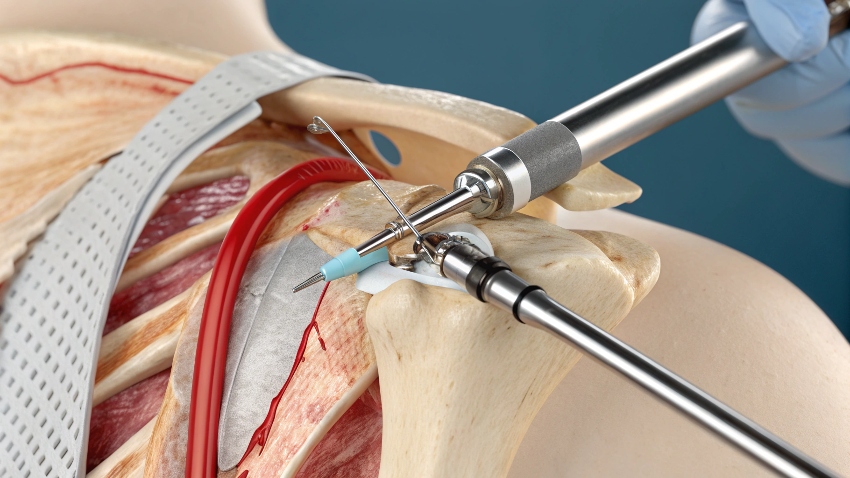
The first shoulder dislocation is usually the most dramatic. A collision, a fall, a sports impact — and then the arm is locked in an abnormal position, exquisitely painful, visibly deformed. The emergency reduction brings immediate relief. The sling brings a false sense of resolution. And then, weeks or months later — sometimes from turning over in bed, sometimes reaching overhead, sometimes from a force barely worth mentioning — the shoulder comes out again. And again. And again.
If you are searching for Bankart repair in Faridabad, this guide explains exactly why recurrent shoulder dislocation happens, what the Bankart lesion is, why surgery is almost always the right answer in younger patients, and what arthroscopic Bankart repair involves at Dr. Sunil Choudhary’s Bone & Joints Clinic.
As Faridabad’s UK-trained orthopedic doctor in Faridabad with subspecialty shoulder surgery experience, Dr. Sunil Choudhary performs arthroscopic Bankart stabilisation as a core component of his shoulder surgery practice — ending the cycle of recurrent dislocation and restoring shoulder confidence.
What Is the Bankart Lesion?
The shoulder joint is the most mobile joint in the human body — and that mobility comes at the cost of inherent instability. The humeral head (ball) sits in a shallow glenoid socket (cup), relying on a fibrocartilaginous rim called the labrum to deepen the socket and provide stability.
When the shoulder dislocates anteriorly (forward) — the most common direction, accounting for 95% of dislocations — the humeral head forcibly exits the socket and tears the anteroinferior labrum away from the glenoid rim. This detachment is the Bankart lesion.
Why the Bankart lesion leads to recurrence:
- The labrum normally deepens the glenoid socket by approximately 50%, significantly increasing the resistance to dislocation
- A detached labrum loses this deepening effect
- Each subsequent dislocation tends to enlarge the labral tear and erode the glenoid bone margin
- Once the labral injury exists, the threshold for redislocation drops with every subsequent episode
Associated injuries in shoulder dislocation:
Hill-Sachs lesion: A posterosuperior humeral head impaction fracture — the dent in the humeral head created when it strikes the glenoid rim during dislocation. Significant Hill-Sachs lesions that “engage” the glenoid rim during shoulder movement contribute mechanically to instability.
Glenoid bone loss: Repeated dislocations progressively erode the anterior glenoid bone margin. When bone loss exceeds 20–25% of the glenoid surface area, soft tissue Bankart repair alone has higher failure rates — bone augmentation (Latarjet procedure) may be required.
Rotator cuff tears: More common in patients over 40 years who dislocate — the cuff tears rather than the labrum during dislocation. For rotator cuff assessment: Rotator Cuff Repair in Faridabad
Recurrence Rates: The Statistics That Make the Surgical Decision Clear
The most important data in shoulder instability management is the age-stratified recurrence rate after conservative management (sling immobilisation followed by physiotherapy):
| Age at First Dislocation | Recurrence Rate Without Surgery |
| Under 20 years | 70–95% |
| 20–29 years | 55–70% |
| 30–39 years | 35–50% |
| 40–49 years | 20–35% |
| Over 50 years | Under 20% |
For patients under 30 who are athletically active, the surgical case after a first dislocation is statistically compelling. For patients who have had two or more dislocations at any age, the surgical case is essentially unambiguous — progressive glenoid bone loss with each episode means delaying surgery makes the eventual reconstruction more complex.
Diagnosing Shoulder Instability at Dr. Sunil Choudhary’s Clinic
Clinical Examination
Dr. Sunil Choudhary’s shoulder instability assessment includes:
Anterior apprehension test: With the arm at 90° abduction and external rotation, applying gentle posterior pressure to the humeral head produces a sense of impending dislocation in patients with anterior instability — highly specific for anterior instability.
Relocation test: Relieving the apprehension by applying anterior pressure to the humeral head confirms the diagnosis.
Load and shift test: With the shoulder in a neutral position, the examiner compresses the humeral head into the glenoid and assesses how much force is needed to shift it anteriorly and posteriorly.
Sulcus sign: For inferior instability — inferior traction on the arm produces a visible dimpling below the acromion.
MRI Arthrogram
Standard MRI may miss small labral tears. MRI arthrogram — with gadolinium contrast injected into the joint before the MRI — significantly improves labral tear detection sensitivity.
What the arthrogram assesses:
- Location and size of the Bankart lesion (anteroinferior labrum)
- Presence of an ALPSA lesion (Anterior Labroligamentous Periosteal Sleeve Avulsion) — a variant where the labrum is stripped medially without complete detachment
- Extent of Hill-Sachs lesion
- Glenoid bone loss (combined with CT scan for quantification)
- Capsular laxity
CT Scan
For glenoid bone loss quantification — essential for surgical planning. The “en-face” view of the glenoid allows measurement of the bony defect as a percentage of the normal glenoid circle.
Arthroscopic Bankart Repair: The Surgical Procedure
Arthroscopic Bankart repair is performed under general anaesthesia with interscalene nerve block. The patient is positioned in the beach-chair position or lateral decubitus.
Surgical steps:
- Diagnostic arthroscopy The entire shoulder joint is systematically inspected — glenohumeral joint, subacromial space, biceps anchor, rotator cuff, and labrum. The Bankart lesion, Hill-Sachs lesion, and any associated pathology are confirmed.
- Labral mobilisation The stripped labrum is elevated off the glenoid neck using an elevator instrument, freeing it from any scar tissue that has formed during healing attempts. This restores tissue mobility for reattachment.
- Glenoid preparation The anterior glenoid rim is abraded with a burr or rasp to create a bleeding bone surface — enhancing the biological healing environment for the reattached labrum.
- Suture anchor placement Titanium or bioabsorbable suture anchors are inserted into the glenoid rim at the 5:30, 4:00, and 2:30 positions (for the right shoulder) — matching the footprint of the detached labrum. Each anchor carries two sutures.
- Suture passage and labral reattachment Arthroscopic suture-passing instruments thread the sutures through the labrum and capsule. Sutures are tied with arthroscopic knot-tying technique, reattaching the labrum to the glenoid rim and simultaneously plicating (tightening) the anterior capsule.
- Remplissage (when indicated) For large, engaging Hill-Sachs lesions — the infraspinatus tendon and posterior capsule are sutured into the Hill-Sachs defect, preventing the defect from engaging the glenoid rim during movement. This modification significantly reduces recurrence rates in patients with engaging Hill-Sachs lesions.
Operative time: 60–90 minutes Hospital stay: Day surgery or overnight (based on anaesthesia recovery) Documented recurrence rate post-surgery: 3–10% in most published series (vs. 60–95% without surgery in young athletes)
Recovery After Bankart Repair in Faridabad
| Phase | Timeline | Key Activity |
| Sling immobilisation | Weeks 0–4 | Arm sling full-time; elbow and hand exercises freely |
| Early mobilisation | Weeks 4–8 | Progressive passive and active-assisted range of motion |
| Active strengthening | Weeks 8–12 | Rotator cuff and periscapular strengthening begins |
| Sport-specific training | Months 3–5 | Return to throwing, overhead, and contact sport preparation |
| Return to contact sport | Month 5–6 | Based on strength symmetry and sports functional testing |
Strictly avoid for the first 6 weeks:
- Reaching behind the back
- External rotation beyond neutral
- Any overhead reaching
- Carrying weights
Why adherence to the sling protocol matters: The repaired labrum must heal back to the glenoid bone — a biological process requiring 12 weeks minimum of protected positioning. Removing the sling early and resuming activity before healing is complete is the primary cause of surgical failure.
For the complete shoulder surgery portfolio: Total Shoulder Replacement in Faridabad
For frozen shoulder co-existing with instability: Frozen Shoulder Treatment in Faridabad
For the Bankart repair service page: Bankart Repair — Dr. Sunil Choudhary
For sports injury context: Sports Injury Treatment in Faridabad
Conclusion: Bankart Repair in Faridabad — End the Cycle Before It Gets Worse
Every dislocation episode damages the shoulder further. The glenoid bone margin erodes. The Hill-Sachs lesion enlarges. The capsule stretches. The point at which a straightforward arthroscopic Bankart repair suffices gives way to a point where a more complex bony reconstruction is required.
Bankart repair in Faridabad at Dr. Sunil Choudhary’s Bone & Joints Clinic is the right intervention at the right time — arthroscopic, precise, and performed by an orthopedic doctor in Faridabad with the UK fellowship-trained shoulder surgery expertise that this technically demanding procedure demands.
Book Your Shoulder Instability Evaluation — Dr. Sunil Choudhary
Recurrent dislocation? Book your assessment before the next episode causes more glenoid bone loss.
Dr. Sunil Choudhary — UK-Trained Shoulder Specialist | Bankart Repair Surgeon in Faridabad