Sciatica Pain Treatment in Faridabad: Why Back and Leg Pain Needs Expert Assessment

Partial Hip Replacement in Faridabad: Who Needs It, What’s Different from Total Hip, and What to Expect
July 22, 2026
Arthroscopic Rotator Cuff Repair in Faridabad: When Your Shoulder Needs More Than Rest
August 4, 2026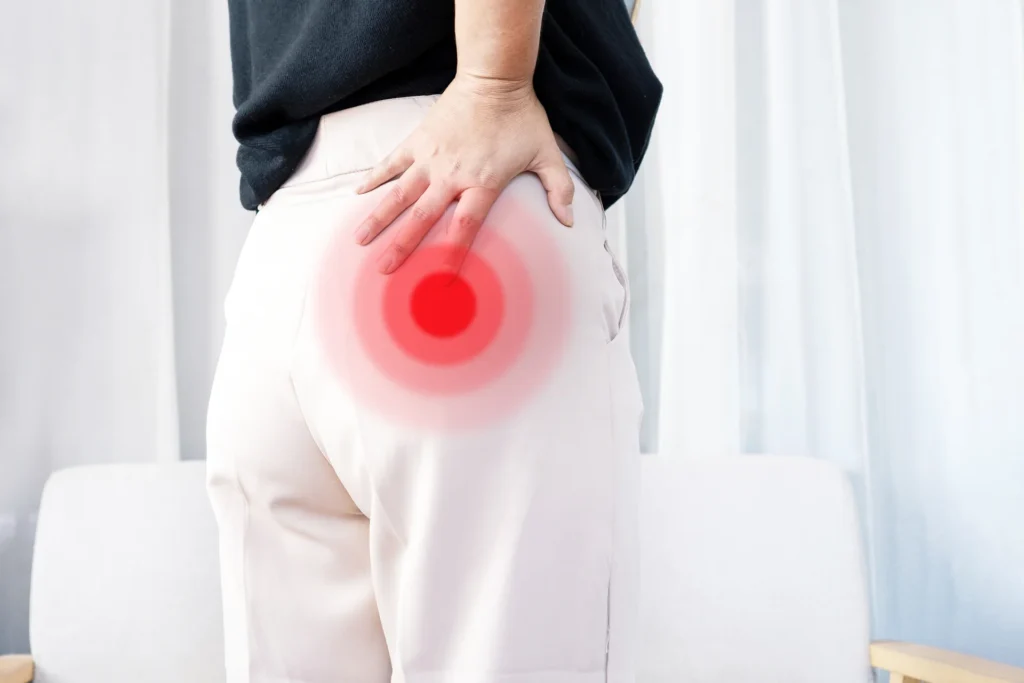
The pain starts in the lower back. Then it spreads — down the buttock, into the thigh, sometimes all the way down the calf to the foot. It can feel like a burning wire, a sharp electric shock, or a deep aching throb. It is worse when sitting. It wakes you at night. Coughing, sneezing, or straining makes it dramatically worse. This is the classic presentation of sciatica — and it is one of the most disabling and mismanaged pain conditions in Faridabad’s population.
Sciatica pain treatment in Faridabad at Dr. Sunil Choudhary’s Bone & Joints Clinic begins with the fundamental step that most sciatica management skips: accurate diagnosis. Not all back-and-leg pain is sciatica, not all sciatica has the same cause, and not all sciatica requires the same treatment. As Faridabad’s UK-trained orthopedic doctor in Faridabad with specific expertise in spinal and nerve pain conditions, Dr. Sunil Choudhary provides the comprehensive assessment and targeted management that genuinely resolves sciatica — rather than suppressing its symptoms temporarily.
What Is Sciatica? Understanding the Anatomy
The sciatic nerve is the largest and longest nerve in the human body. It originates from nerve roots at L4, L5, S1, S2, and S3 in the lumbar and sacral spine — these roots merge in the pelvis to form the sciatic nerve, which exits through the greater sciatic foramen and passes through the buttock, down the posterior thigh, dividing into the peroneal and tibial nerves below the knee.
Sciatica — technically called lumbar radiculopathy — describes pain, numbness, tingling, or weakness originating from compression or irritation of one or more of these sciatic nerve roots.
Critical distinction: Sciatica is a symptom, not a diagnosis. The underlying cause of the nerve root compression determines both the prognosis and the treatment approach.
Causes of Sciatica — What Is Actually Compressing the Nerve?
Lumbar Disc Herniation (Most Common Cause — 90%)
The intervertebral disc — a fibrocartilaginous cushion between each vertebra — has a tough outer ring (annulus fibrosus) and a gel-like centre (nucleus pulposus). When the annulus tears, the nucleus can herniate through it and press against the adjacent nerve root.
L4-L5 disc herniation — compresses the L5 nerve root; causes pain down the outer shin to the top of the foot; weakness of big toe extension (foot drop in severe cases)
L5-S1 disc herniation — the most common level; compresses the S1 nerve root; causes pain down the posterior calf to the heel and outer foot; reduced ankle reflex; weakness of plantarflexion
Mechanism: Typically from a bending or twisting injury, heavy lifting, or prolonged sitting — but can occur without any identified trigger. The nucleus pulposus itself contains inflammatory mediators (phospholipase A2, cytokines) that cause chemical nerve root irritation even without mechanical compression — explaining why some patients have severe pain from small herniations.
Lumbar Spinal Stenosis
Narrowing of the spinal canal from degenerative changes — facet joint hypertrophy, ligamentum flavum thickening, osteophyte formation, and disc bulging — that collectively reduce the space for the nerve roots.
Characteristic presentation: Neurogenic claudication — bilateral buttock and leg pain that comes on with walking and is relieved by sitting, squatting, or leaning forward (positions that increase the canal diameter). Unlike vascular claudication, the pain is provoked by walking and standing rather than purely by walking.
Who gets stenosis: Predominantly patients over 60; strongly associated with degenerative spine disease; gradually progressive over years.
Piriformis Syndrome
The sciatic nerve normally passes inferior to the piriformis muscle as it exits the pelvis. In approximately 17% of people, the sciatic nerve passes through the belly of the piriformis. When the piriformis is tight, inflamed, or hypertrophied — from overuse, trauma, or anatomical variation — it compresses the sciatic nerve.
Distinguishing features from disc herniation:
- No neurological deficit (no weakness or reflex change)
- Pain reproduced by direct piriformis palpation through the buttock
- Positive FAIR test (Flexion, Adduction, Internal Rotation)
- Normal lumbar spine MRI
Piriformis syndrome accounts for approximately 6% of sciatica cases and is frequently misdiagnosed as lumbar disc disease.
Spondylolisthesis
Forward slippage of one vertebra over the one below — from degenerative joint disease, pars stress fracture (isthmic spondylolisthesis), or traumatic disruption. The slippage narrows the neural foramen through which the nerve root exits the spine, causing foraminal stenosis and nerve compression.
Other Causes
- Sacroiliac joint dysfunction — pain referred into the buttock and proximal thigh from the SI joint; distinguishable clinically from true radiculopathy by its distribution (rarely below the knee) and positive provocation tests (FABER, POSTERIOR SHEAR)
- Spinal tumours or metastases — sciatica that is constant, progressive, not relieved by any position, associated with unexplained weight loss, or in a patient with known cancer requires urgent investigation
- Cauda equina syndrome — bilateral sciatica with bladder or bowel dysfunction (retention, incontinence) is a surgical emergency
Diagnosing Sciatica at Dr. Sunil Choudhary’s Clinic in Faridabad
Clinical Examination
Straight Leg Raise (SLR) test: With the patient lying flat, the examiner raises the straight leg. Reproduction of the patient’s radicular leg pain between 30° and 70° of elevation is positive — and indicates nerve root tension, typically from L4-L5 or L5-S1 disc herniation.
Crossed SLR: Raising the contralateral leg reproduces radicular pain in the symptomatic leg — a highly specific sign of central or paracentral disc herniation.
Neurological examination: Sensory testing in dermatomal distributions; motor testing of key muscles (hip flexion, knee extension, ankle dorsiflexion, big toe extension, ankle plantarflexion, toe flexion); deep tendon reflexes (knee jerk L4, ankle jerk S1).
MRI of the Lumbar Spine
The gold standard investigation for sciatica — identifying the level and cause of nerve root compression, the degree of disc herniation, the canal diameter in stenosis, and any spondylolisthesis or tumour.
Important clinical caveat: Disc bulges and herniations are present on MRI in 30–40% of asymptomatic adults. The clinical examination determines which MRI finding is responsible for the patient’s symptoms — not every finding on an MRI report is pathological.
Sciatica Pain Treatment Options in Faridabad
Conservative Management (First Line — 85% of Sciatica Resolves Without Surgery)
Most lumbar disc herniation-related sciatica resolves within 6–12 weeks with structured conservative management. The natural history of disc herniation is spontaneous resolution — the extruded nucleus pulposus undergoes progressive absorption by the body’s immune system over weeks to months.
Effective conservative management at Dr. Sunil Choudhary’s clinic:
Analgesia: NSAIDs (ibuprofen, naproxen, etoricoxib) — reduces the inflammatory component of nerve root irritation. Neuropathic agents (pregabalin, gabapentin) — specifically effective for the burning, shooting, electric pain quality of radiculopathy.
Physiotherapy: McKenzie exercises (prone press-ups and extension exercises) — particularly effective for posterolateral disc herniation causing sciatica; centralises pain from the leg toward the back as the nucleus is displaced away from the nerve root. Neurodynamic exercises (neural mobilisation) — reduce intraneural oedema and restore sciatic nerve mobility.
Selective nerve root block / epidural steroid injection: Fluoroscopy or CT-guided injection of corticosteroid around the compressed nerve root. Provides rapid, targeted anti-inflammatory effect at the exact site of compression. Most effective within the first 3 months of symptoms; reduces the need for surgery in a significant proportion of patients.
Activity modification: Brief relative rest (2–3 days) in the most acute phase; then gradual return to normal activity. Prolonged bed rest is not only unhelpful — it is harmful, leading to muscle deconditioning and slower recovery.
For back pain management broadly: Best Back Pain Specialist in Faridabad
For nerve pain management: Best Nerve Pain Surgeon in Faridabad
Surgical Treatment — When Operation Is Appropriate
Surgery is indicated for sciatica when:
- Cauda equina syndrome — urgent/emergency surgery; bowel or bladder dysfunction with bilateral leg weakness
- Progressive neurological deficit — worsening foot drop or limb weakness despite conservative management
- Intractable pain — severe, disabling pain unresponsive to 6–8 weeks of appropriate conservative treatment
- Failed conservative treatment at 12 weeks — persistent significant sciatica despite adequate non-surgical management
Surgical options:
Microdiscectomy: The definitive surgical treatment for lumbar disc herniation causing sciatica. A 2–3 cm incision over the affected level; operating microscope provides magnified, illuminated access; the herniated disc fragment is removed from the nerve root with minimal surrounding tissue disruption. Operative time: 45–60 minutes. Discharge: same day or next morning. Return to light activity: 2–3 weeks. Return to physical work: 6–8 weeks.
Lumbar decompression (laminectomy): For spinal stenosis causing neurogenic claudication — the facet joints and ligamentum flavum are trimmed to widen the spinal canal and relieve neural compression.
Spinal fusion: For spondylolisthesis causing instability — the unstable segment is stabilised with pedicle screws and a bone graft or cage, restoring alignment and eliminating the source of nerve compression.
For osteoarthritis causing secondary spinal stenosis: Best Osteoarthritis Surgeon in Faridabad
For sciatica service page: Sciatica Pain Specialist in Faridabad
Warning Signs That Require Urgent Assessment — Do Not Delay
These symptoms in the context of back and leg pain require same-day or emergency evaluation:
- New difficulty urinating or loss of urinary control — cauda equina syndrome; surgical emergency
- New bowel incontinence or retention — cauda equina syndrome
- Saddle anaesthesia — numbness in the perineum, inner thighs, and genitalia
- Rapidly progressive leg weakness — foot drop developing over hours to days
- Sciatica with fever, night sweats, or unexplained weight loss — possible spinal infection or malignancy
Conclusion: Expert Sciatica Pain Treatment in Faridabad at Dr. Sunil Choudhary’s Clinic
Sciatica pain treatment in Faridabad works when it is based on accurate diagnosis of the underlying cause — not a blanket prescription of painkillers and physiotherapy applied to every patient regardless of what is actually compressing their nerve. At Dr. Sunil Choudhary’s Bone & Joints Clinic, every sciatica patient receives the clinical examination, MRI correlation, and targeted treatment plan — conservative or surgical — that their specific nerve compression requires.
As an experienced orthopedic doctor in Faridabad with UK fellowship training and over 20 years of musculoskeletal practice, Dr. Sunil Choudhary resolves sciatica where it originates — not just manages the symptom.
Book Your Sciatica Evaluation — Dr. Sunil Choudhary, Faridabad
Shooting leg pain, foot numbness, or back pain that hasn’t settled in 6 weeks — get an accurate diagnosis today.
Dr. Sunil Choudhary — UK-Trained Sciatica & Spine Pain Specialist | Best Orthopedic Doctor in Faridabad