
Insurance and Cashless Treatment for Joint Replacement: What Actually Happens

Returning to Cricket After ACL Reconstruction
October 18, 2026
Can I Sit Cross-Legged After a Knee or Hip Replacement?
October 29, 2026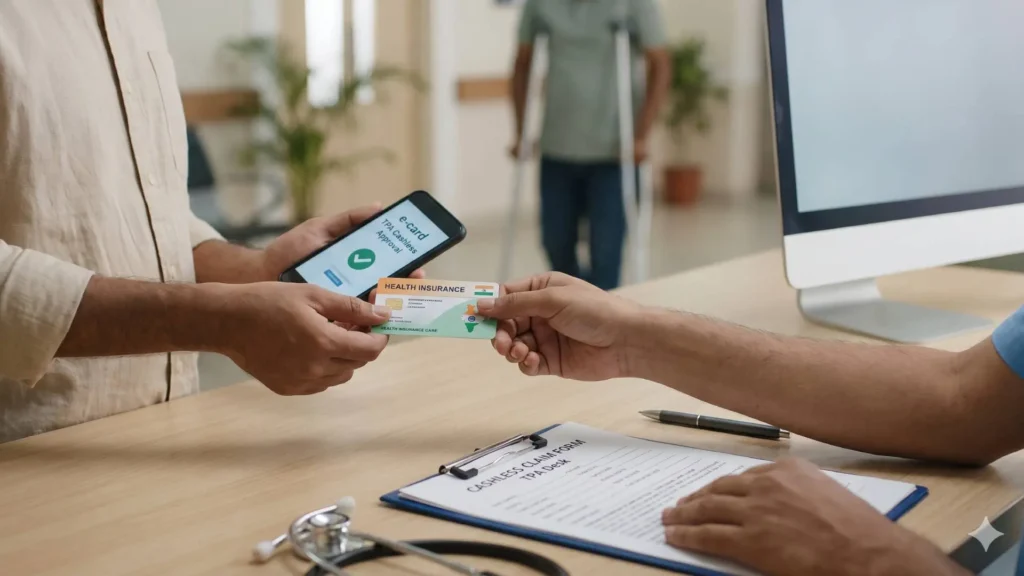
Most people decide to have a joint replacement, and then discover that the harder problem is working out how to pay for it. The hospital says insurance is accepted. The insurer says the claim is under review. Nobody explains the parts that actually determine what you end up paying.
This is the guide I wish patients had before they came in. It is written for Indian health insurance specifically, and it covers the things that cause the unpleasant surprises.
Cashless or reimbursement — know which you are doing
There are two ways a claim works, and they feel completely different to you.
Cashless
The hospital bills your insurer directly through the TPA. You pay only the deductions and non-covered items at discharge. This requires the hospital to be in your insurer’s network, and it requires pre-authorisation approved before admission.
Reimbursement
You pay the full bill yourself, then claim it back afterwards with the documents. You get the money eventually, but you need the whole amount available upfront. This is what happens if the hospital is outside the network, or if pre-authorisation was not obtained in time.
For planned surgery there is almost never a good reason to end up in the reimbursement route. It happens when the paperwork is started too late.
The waiting period — the one that catches most people out
This is the single most common reason a joint replacement claim is refused, and most policyholders do not know it exists.
Indian health policies carry specific waiting periods for named procedures, and joint replacement is almost always on that list. Depending on the policy, it is commonly two to four years from the date the policy started — separate from, and longer than, the general 30-day initial waiting period.
There is also a pre-existing disease waiting period. If your arthritis was diagnosed before you took the policy and you declared it, the clock on that condition runs separately.
What to do: find your policy wording — the full document, not the one-page summary — and look for “specific waiting period” or “named ailment waiting period”. Check the date your first policy with that insurer started, not the current renewal date. If you ported from another insurer, continuous coverage usually carries over, but you need to be able to prove it.
Room rent capping and proportionate deduction
This one costs people real money and almost nobody understands it until the bill arrives.
Many policies cap the room category you are entitled to — often as a percentage of the sum insured per day, or as a named category. If you take a room above your entitlement, most insurers apply a proportionate deduction: they reduce not just the room charge but a proportion of the entire associated bill — surgeon’s fees, anaesthesia, nursing, investigations.
So upgrading your room by a few thousand rupees a day can reduce the payable portion of a bill many times larger. It is the most expensive small decision in the whole process.
What to do: ask your insurer or TPA, in writing, which room category you are entitled to. Then book exactly that. If you want to upgrade for comfort, ask the hospital billing desk to show you what the proportionate deduction would come to first.
What is usually covered, and what is not
Usually covered
- Surgeon, anaesthetist and assistant fees
- Operating theatre charges
- The implant — usually covered, but confirm, and confirm whether there is a cap
- Room and nursing within your entitled category
- Pre-operative investigations within the defined window before admission
- Post-hospitalisation expenses for a defined period after discharge
Usually NOT covered
- Non-medical consumables — gloves, syringes, administrative charges and similar. This is often a meaningful sum and is the commonest line item people are surprised by
- Attendant charges, food for relatives, telephone and similar
- Charges above your room entitlement, plus the proportionate deduction that follows
- Any co-pay written into your policy — a fixed percentage you bear on every claim, common in senior-citizen policies
- Treatment taken before the waiting period ends
- Often, the premium portion for newer technology above a standard benchmark — worth asking specifically if you are considering robotic knee replacement surgery in Faridabad, since the additional cost may not be reimbursed
The pre-authorisation process, step by step
- Decide on surgery and get a date. Nothing starts before this.
- The hospital insurance desk prepares the pre-authorisation request — diagnosis, planned procedure, estimated cost, duration of stay, and the surgeon’s clinical notes supporting the need for surgery.
- Submit at least 5 to 7 days before a planned admission. This is the step that goes wrong. Submitted the day before, you will very likely end up paying and claiming back.
- The TPA reviews it and either approves, approves partially, raises a query, or rejects.
- Answer queries fast. Most delays are a missing document, not a refusal. Keep your phone on.
- Approval letter issued, stating the approved amount — which may be less than the estimate.
- Admission and surgery.
- Enhancement if needed. If the stay or cost exceeds the approval, the hospital files an enhancement request during admission, not after.
- Final approval and discharge. You settle the deductions and non-covered items.
Documents to have ready before you come in
- Insurance card and policy number
- The full policy wording document — not the summary
- Photo ID and address proof
- All previous consultation notes and prescriptions relating to the joint
- X-rays and MRI films with reports
- Records of how long the problem has been present and what non-surgical treatment you have tried — insurers frequently ask for evidence that conservative treatment was attempted first
- For corporate policies, your employee ID and HR contact
Government and employer schemes
Beyond retail insurance, joint replacement may be covered under Ayushman Bharat PM-JAY for eligible families, CGHS for central government employees and pensioners, ECHS for ex-servicemen, state government schemes, and ESIC. Each has its own empanelment, referral and approval process, and the referral usually has to be obtained before admission rather than afterwards.
If you fall under any of these, start that process before booking a date — the referral step is where most of the time goes.
If you have no insurance, or the waiting period has not finished
Say so early rather than late. Knowing it upfront changes what can be planned: the timing of surgery, the implant selected, the room category, the length of stay, and whether both joints are done together or separately. Many hospitals also offer structured payment options.
What you should not do is delay surgery indefinitely on cost grounds without a review. Arthritis that progresses while you wait can turn a straightforward knee replacement surgery in Faridabad into a more complex operation, and a deformity that becomes fixed is harder and more expensive to correct.
Five questions to ask before you fix a date
- “Has my specific waiting period for joint replacement finished?” — ask the insurer, not the hospital
- “Which room category am I entitled to?”
- “Is the implant covered, and is there a cap on it?”
- “Does my policy have a co-pay, and what percentage?”
- “Roughly what will the non-covered consumables come to?” — the hospital billing desk can estimate this
Bring Your Policy to the Consultation
Our team handles pre-authorisation for knee replacement surgery in Faridabad, hip replacement surgery in Faridabad, shoulder replacement surgery in Faridabad and revision knee replacement in Faridabad. Bring your full policy document to your appointment with Dr. Sunil Choudhary — a UK-trained best orthopedic doctor in Faridabad — and we will go through it with you and give you a written estimate before anything is scheduled. Bone & Joints Clinic, Sector 42, or the Asian Institute of Medical Sciences, Sector 21A. Call +91 97177 67209 or +91 99717 09209.
Author & Medical Review
Medically reviewed by Dr. Sunil Choudhary, MBBS, MS (Orthopaedics), DNB, MRCS, FRCS (Trauma & Orthopaedics) — Royal College of Surgeons of England. Senior Consultant and Unit Head, Orthopaedics, Asian Institute of Medical Sciences, Faridabad.
FAQs
Can I claim for both knees done at the same time?
Usually yes, as a single admission, though the approved amount for the second side is often lower. Confirm it in the pre-authorisation rather than assuming.
My claim was rejected. Is that final?
Often not. A significant proportion of rejections are documentation problems rather than genuine exclusions. Ask for the rejection reason in writing and appeal with the missing evidence. Insurers also have a grievance process and an ombudsman above that.
Does insurance cover physiotherapy after discharge?
Post-hospitalisation expenses are usually covered for a defined period, which often includes prescribed physiotherapy. Check the duration in your policy — it varies considerably.
Will my premium go up after a claim?
Most Indian health policies do not load the premium for an individual claim, though you may lose a no-claim bonus. Policy terms vary, so check yours.
Is revision surgery covered?
Generally yes, but documentation requirements are stricter and the insurer will want evidence of why the first implant failed. Keep your original surgery records and implant stickers — patients frequently cannot find them years later.

