Robotic Knee Replacement Surgery in Faridabad: How Technology Is Transforming Joint Care

Best Knee Replacement Surgeon in Faridabad: What You Need to Know Before Deciding on Surgery
November 6, 2026
ACL Treatment in Faridabad: Surgery, Rehabilitation and Full Return to Sport
November 14, 2026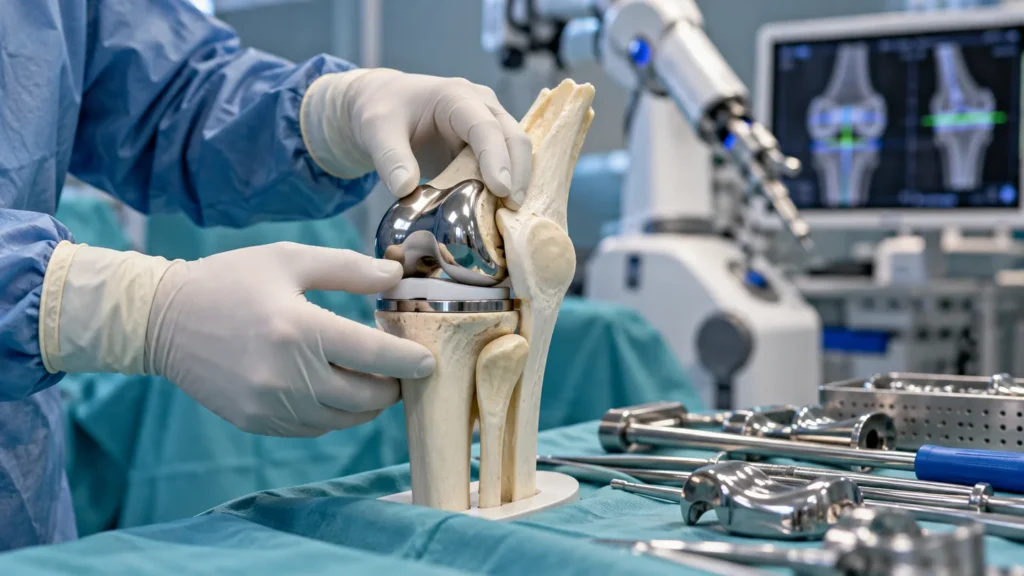
Robotic knee replacement surgery in Faridabad at Dr. Sunil Choudhary’s practice represents the most significant advancement in joint replacement in a generation. For patients who want the highest chance of a durable, long-lasting result — particularly those who are younger, more active, or simply demand the best available outcome — robotic-assisted surgery offers measurable advantages over traditional manual technique that decades of data are beginning to confirm.
What Is Robotic Knee Replacement Surgery? A Plain-Language Explanation
Step 1 — Pre-operative CT scan. A CT scan of the patient’s knee, hip, and ankle is taken before surgery. This creates a 3D digital model of that specific patient’s anatomy.
Step 2 — Surgical plan. Using the CT data, the surgeon plans the exact size, position, and angle of every implant component on a computer — matching the plan to the patient’s individual anatomy, not an average template.
Step 3 — Intra-operative robotic guidance. During surgery, a robotic arm is attached to the operating table, pre-programmed with the surgical plan. When the surgeon cuts bone, the arm physically constrains the cutting tool to operate only within a defined “safe zone” — within 1 mm and 1° of the plan.
Step 4 — Real-time feedback. As soft tissue balance is assessed during surgery, the system provides real-time data allowing the surgeon to refine the plan before any bone is cut.
Why Implant Alignment Is the Most Important Factor in Knee Replacement Longevity
- Implants placed outside a 3° deviation from the correct mechanical axis have a 24× higher failure rate at 10 years
- Soft tissue imbalance is the most common cause of persistent pain after replacement — preventable with real-time intra-operative balancing data
- Manual surgery produces outlier alignments in 20–30% of cases; robotic surgery reduces this to under 5%
Who Is the Best Candidate for Robotic Knee Replacement Surgery in Faridabad?
Younger, More Active Patients (under 65)
Every percentage point of improvement in implant alignment improves long-term survival. A 55-year-old who needs their replacement to last 25 years has the most to gain.
Patients Having Partial (Unicondylar) Knee Replacement
Partial knee replacement is a technically demanding procedure where component alignment has an outsized effect on outcome. Robotic-assisted arthroplasty is particularly well-suited here — the precision required to perfectly position a small unicompartmental implant is exactly what the robotic system excels at.
Patients with Unusual Anatomy
Previous knee fractures, bowing of the leg (varus deformity), or prior knee surgeries create anatomy that manual guides are not designed for. Robotic surgery plans around the patient’s actual anatomy.
Robotic Knee Replacement vs. Manual Knee Replacement
- Bone cutting accuracy: Manual ±2–4 mm / ±3–5° vs Robotic ±1 mm / ±1°
- Soft tissue balancing: Manual (visual + feel) vs Robotic (real-time quantitative data)
- Implant outliers (>3° from plan): Manual 20–30% vs Robotic <5%
- Hospital stay: Manual 3–4 days vs Robotic often 2–3 days
Recovery from Robotic Knee Replacement
Post-operative protocol is similar to manual replacement. However, registry and clinical data suggest: less post-operative pain from better alignment, faster return to full activity (1–2 week earlier), and lower rate of persistent knee pain. By 3 months, most patients are walking without aids. By 6 months, most report the operated knee as “normal.”
Book Your Robotic Knee Replacement Consultation in Faridabad
Dr. Sunil Choudhary | MS (Orthopaedics) | Robotic Joint Replacement Surgeon in Faridabad | Bring your X-rays and any existing MRI or CT reports. Same-week appointments available at drsunilchoudhary.in.
Author & Medical Review
Dr. Sunil Choudhary, MS (Orthopaedics) — Robotic joint replacement surgeon in Faridabad trained in computer-assisted total and partial knee and hip replacement.
FAQs
Is robotic knee replacement surgery available in Faridabad?
Yes. Dr. Sunil Choudhary offers computer-assisted robotic joint replacement surgery for both total and partial knee replacement — and for hip replacement — in Faridabad, without patients needing to travel to Delhi.
Is robotic knee replacement more expensive than traditional surgery?
There is typically a modest additional cost for the robotic platform. For younger or more active patients where long-term implant survival is the priority, this investment is well-supported by the alignment data.
Does robotic surgery mean the robot performs the operation?
No. The robotic arm does not perform the surgery independently. It is a precision tool — a physical constraint — that the surgeon operates within. The surgeon makes every decision; the robotic arm ensures those cuts are executed with accuracy that manual technique cannot reliably match.
Is recovery from robotic knee replacement faster than traditional?
Clinical data suggests modest improvements in early recovery — less post-operative pain, slightly faster return to independent function. The difference becomes more apparent at 2–5 years, where better alignment correlates with lower rates of persistent pain.
Can I have robotic partial knee replacement in Faridabad?
Yes. Robotic-assisted arthroplasty is particularly well-suited to partial knee replacement, where precise component positioning has an outsized effect on outcome. It is available at Dr. Sunil Choudhary’s practice.